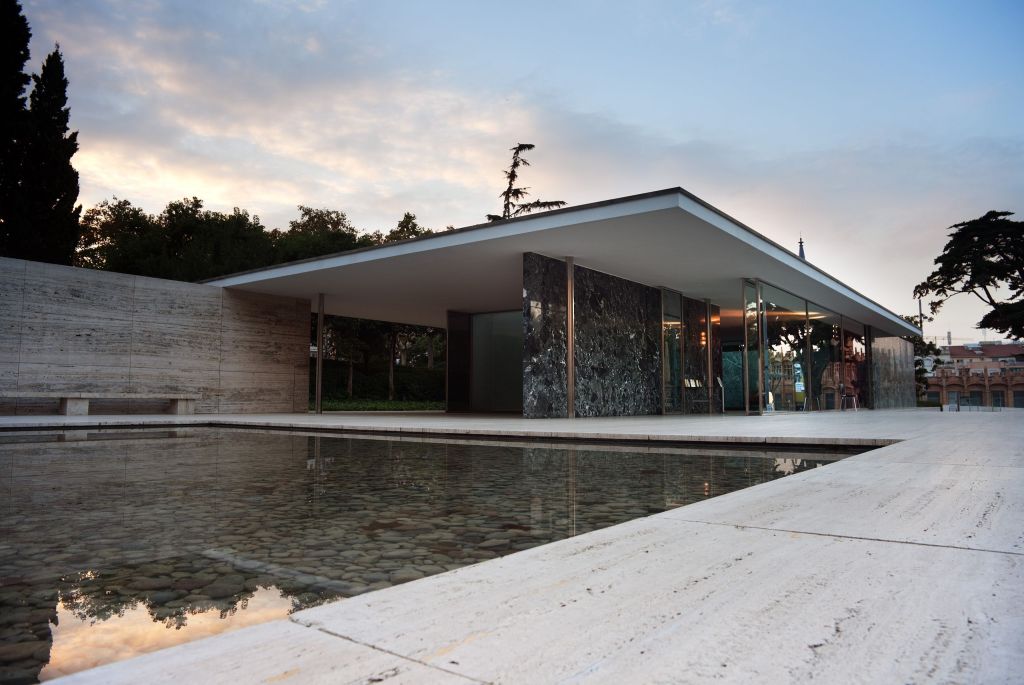
Achitecture as one of the the greatest preserver of art. Simplicity is sophistication.
The Barcelona Pavilion, designed by Ludwig Mies van der Rohe in 1929, is a masterpiece of modern architecture. Built as the German Pavilion for the International Exposition in Barcelona, it embodies Mies’ famous principle, „less is more.”
Unlike other pavilions at the exposition, Mies understood his pavilion simply as a building and nothing more, it would not house art or sculpture rather the pavilion would be a place of tranquility and escape from the exposition, in effect transforming the pavilion into an inhabitable sculpture. (Source:Archdaily)
The original structure was demolished in 1930, but in 1983 a group of Catalan architects began working on rebuilding the pavilion.
1. Architectural Style
- Modernist: The pavilion is a symbol of the modernist movement, emphasizing simplicity, openness, and material innovation.
- Minimalist Design: Clean lines, geometric forms, and a seamless integration of materials.
2. Materials
- Luxurious materials emphasize simplicity with sophistication:
- Marble (creates a symmetrical patternization through a process of splitting, called broaching)
- Glass (clear and colored)
- Steel (chrome-plated columns)
- Travertine (flooring and exterior walls; with luminous qualities)
3. Design Features
- Open Plan: The spaces flow organically without strict separation, dissolving the boundary between interior and exterior.
- Floating Roof: Supported by slim chrome-covered columns, creating an impression of lightness and elevation.
- Reflection and Transparency: Large glass panels and reflective surfaces enhance the sense of space and openness.
- Axial Symmetry: Adds to the pavilion’s elegance and order.
The elegant and sleek design was meant to serve as a space for contemplation and reception.
Mies’ approach of „less is more” became foundational in modern design, emphasizing the interplay between structure and space.


 Crâmpeie din viață by Nicoleta
Lasă un comentariu